Zhongnanhai
The walled lake garden beside the Forbidden City where China's leadership has worked since 1949, and the ledger of the state presidency.
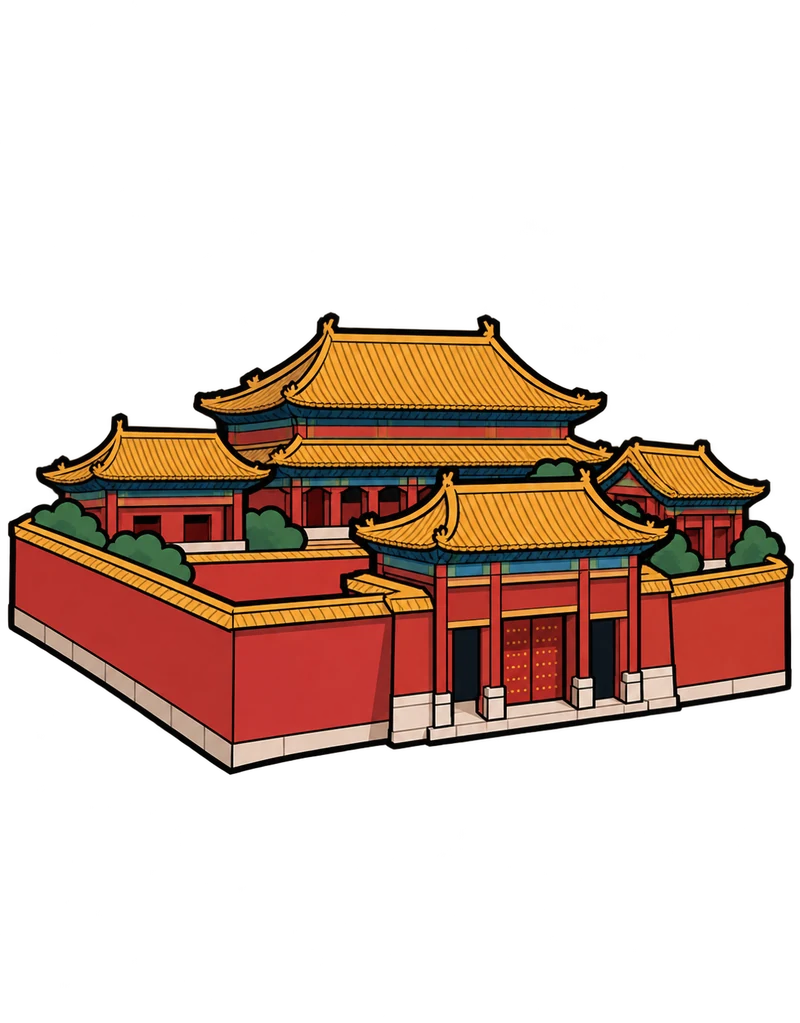
Zhongnanhai means "Central and Southern Seas." It is a walled compound around two artificial lakes, directly west of the Forbidden City in Beijing. Since 1949 it has been the headquarters of both the Chinese Communist Party and the State Council, the country's cabinet. It is closed to the public. Most people know it only by its main entrance on Chang'an Avenue, the Xinhua Gate.
| Building | Zhongnanhai |
|---|---|
| What Wikidata calls it | Chinese garden |
| Capital | Beijing |
| Form of government | communist party-led state |
| Population | 1,404,890,000 |
The place
The lakes were dug as imperial pleasure gardens, and the Ming and Qing emperors used them as a retreat from the formal courts of the Forbidden City. The Guangxu Emperor was held there under house arrest after the failed reforms of 1898. After the founding of the People's Republic in October 1949, the new leadership moved in, and it has worked there ever since. Unlike most seats of power on this globe, Zhongnanhai is a compound and not a single building, and it houses the party and the government side by side.
Who held the office
The state office in this ledger is the President of the People's Republic of China, called Chairman before 1982. The ledger records 8 holders. The table has a long gap, and the gap is the history:
- Mao Zedong held the office from 1954 to 1959, and Liu Shaoqi from 1959.
- Liu was purged in the Cultural Revolution and formally removed in October 1968. Dong Biwu acted in the post afterwards, and the source gives no dates for that period.
- The 1975 constitution abolished the office.
- The 1982 constitution restored it, and Li Xiannian took it in 1983.
- In March 2018 the National People's Congress removed the limit of two consecutive five-year terms. Xi Jinping, president since March 2013, began a third term in 2023.
| # | Held by | From | To | Party |
|---|---|---|---|---|
| Xi Jinping | March 14, 2013 | incumbent | ||
| Hu Jintao | March 15, 2003 | March 14, 2013 | ||
| Jiang Zemin | March 27, 1993 | March 15, 2003 | ||
| 4 | Yang Shangkun | April 9, 1988 | March 27, 1993 | |
| 3 | Li Xiannian | June 18, 1983 | April 8, 1988 | |
| 2 | Liu Shaoqi | April 27, 1959 | October 31, 1968 | |
| 1 | Mao Zedong | September 27, 1954 | April 27, 1959 | |
| Dong Biwu | not recorded | not recorded |
8 tenures, 1 without a recorded date. Source: Wikidata, retrieved 2026-09-23.
What the ledger does not show
In China, the state presidency is not the source of power. The source of power is the party, and since 1993 the same person has usually held three posts at once: General Secretary of the Communist Party, Chairman of the Central Military Commission, and state president. GovGlobe records state offices from public records. The party's own offices are not in the ledger yet, and this page will say so until they are.
The Premier leads the State Council, the government that runs the ministries.
| # | Held by | From | To | Party |
|---|---|---|---|---|
| Li Qiang | March 11, 2023 | incumbent | ||
| 7 | Li Keqiang | March 15, 2013 | March 11, 2023 | |
| 6 | Wen Jiabao | March 16, 2003 | March 15, 2013 | |
| Zhu Rongji | March 17, 1998 | March 16, 2003 | ||
| Li Peng | April 12, 1988 | March 17, 1998 | ||
| Hua Guofeng | February 2, 1976 | September 10, 1980 | ||
| Zhou Enlai | September 27, 1954 | January 8, 1976 | ||
| Zhao Ziyang | not recorded | not recorded |
8 tenures, 1 without a recorded date. Source: Wikidata, retrieved 2026-09-23.
Last updated September 22, 2026.