The Élysée Palace
An eighteenth-century town house on the Rue du Faubourg Saint-Honoré, home of the French presidency, and the ledger of every president since 1848.
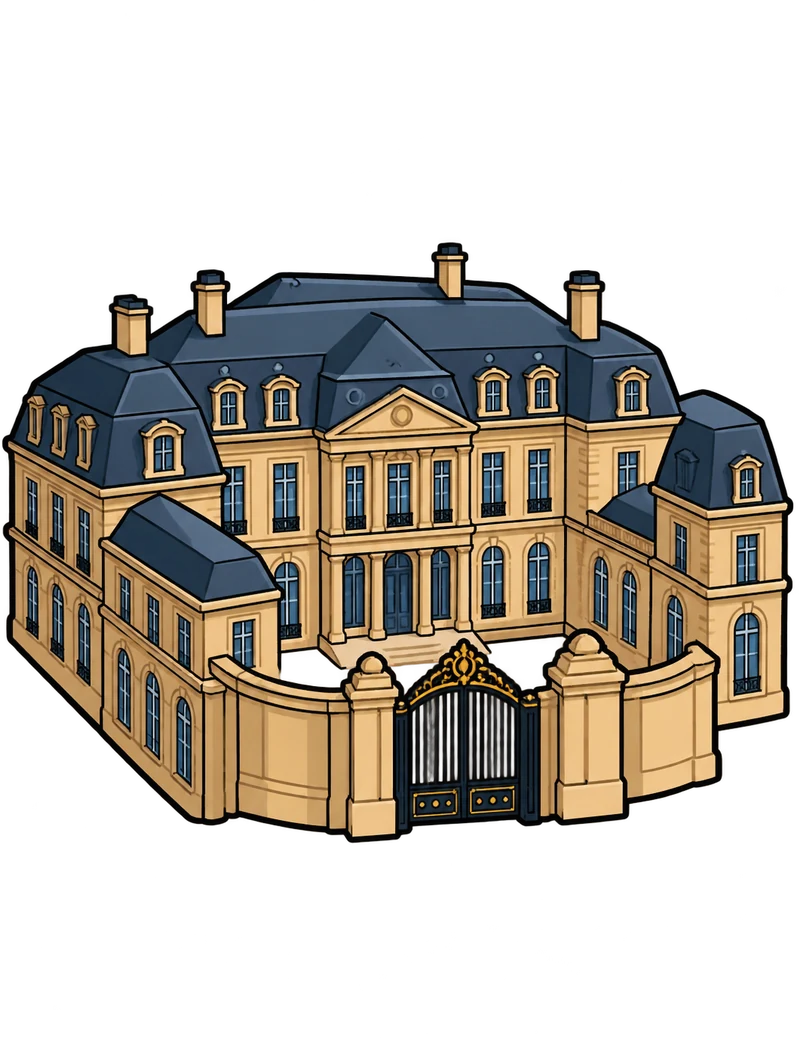
The Élysée Palace is the official residence and office of the President of the French Republic. It stands on the Rue du Faubourg Saint-Honoré in the 8th arrondissement of Paris, a short walk from the Champs-Élysées, which gives it its name. It was built as a private town house, and it still looks like one from the street.
| Building | Élysée Palace |
|---|---|
| What Wikidata calls it | official residence |
| Capital | Paris |
| Form of government | semi-presidential republic |
| Population | 68,605,616 |
The building
The house was built between 1718 and 1722 for Louis-Henri de La Tour d'Auvergne, Count of Évreux, to a design by the architect Armand-Claude Mollet. It was a hôtel particulier: a grand private house with a courtyard in front and a garden behind. Louis XV bought it for Madame de Pompadour, and later owners included the financier Nicolas Beaujon, Napoleon's family and the restored Bourbons.
Louis-Napoléon Bonaparte moved in after he was elected president in December 1848. When he made himself emperor four years later, he moved to the Tuileries Palace. The Third Republic settled its presidents at the Élysée in the 1870s, and every president of the Third, Fourth and Fifth Republics has worked there since. The prime minister has a separate seat across the river, the Hôtel Matignon.
Who held the office
The ledger records 32 terms in the presidency since 1848, held by 31 people. The table has three gaps, and each one is a period when France had no president:
- 1852–1870: the Second Empire, when Louis-Napoléon ruled as Napoleon III.
- 1940–1946: the Vichy regime and the Liberation. Philippe Pétain was "Chief of the French State," a different office, and the ledger does not count him as president.
- Interims: the table also shows short caretaker holders. The President of the Senate acts as president when the office falls vacant, which is why Alain Poher appears twice, in 1969 after Charles de Gaulle resigned and in 1974 after Georges Pompidou died.
| # | Held by | From | To | Party |
|---|---|---|---|---|
| Emmanuel Macron | May 14, 2017 | incumbent | ||
| François Hollande | May 15, 2012 | May 14, 2017 | ||
| Nicolas Sarkozy | May 16, 2007 | May 15, 2012 | ||
| Jacques Chirac | May 17, 1995 | May 16, 2007 | ||
| François Mitterrand | May 21, 1981 | May 17, 1995 | ||
| Valéry Giscard d'Estaing | May 27, 1974 | May 21, 1981 | ||
| Alain Poher | April 3, 1974 | May 27, 1974 | ||
| Georges Pompidou | June 20, 1969 | April 2, 1974 | ||
| Alain Poher | April 28, 1969 | June 20, 1969 | ||
| Charles de Gaulle | January 8, 1959 | April 28, 1969 | ||
| René Coty | January 16, 1954 | January 8, 1959 | ||
| Vincent Auriol | January 16, 1947 | January 16, 1954 | ||
| Georges Bidault | June 24, 1946 | October 14, 1946 | ||
| 15 | Albert Lebrun | May 10, 1932 | July 11, 1940 | |
| Paul Doumer | June 13, 1931 | May 7, 1932 | ||
| Gaston Doumergue | June 13, 1924 | June 13, 1931 | ||
| Frédéric François-Marsal | June 11, 1924 | June 13, 1924 | ||
| Alexandre Millerand | September 23, 1920 | June 11, 1924 | ||
| Paul Deschanel | February 18, 1920 | September 21, 1920 | ||
| Raymond Poincaré | February 18, 1913 | February 18, 1920 | ||
| Armand Fallières | February 18, 1906 | February 18, 1913 | ||
| Émile Loubet | February 18, 1899 | February 18, 1906 | ||
| Félix Faure | January 17, 1895 | February 16, 1899 | ||
| Jean Casimir-Perier | June 27, 1894 | January 16, 1895 | ||
| Charles Dupuy | June 25, 1894 | June 27, 1894 | ||
| Sadi Carnot | December 3, 1887 | June 25, 1894 | ||
| Jules Grévy | January 30, 1879 | December 2, 1887 | ||
| Patrice de MacMahon | May 24, 1873 | January 30, 1879 | ||
| Adolphe Thiers | August 31, 1871 | May 24, 1873 | ||
| Louis Jules Trochu | September 4, 1870 | January 22, 1871 | ||
| Napoleon III | December 20, 1848 | December 2, 1852 | ||
| Louis-Eugène Cavaignac | June 28, 1848 | December 20, 1848 |
32 tenures. Source: Wikidata, retrieved 2026-09-23.
Two heads of the executive
The Fifth Republic, founded in 1958, splits executive power. The president is elected directly for five years and appoints the prime minister, who must keep the confidence of the National Assembly. When the president's party loses the Assembly, the two offices are held by opponents. The French call that cohabitation, and it happened in 1986, 1993 and 1997.
| # | Held by | From | To | Party |
|---|---|---|---|---|
| Sébastien Lecornu | September 9, 2025 | incumbent | ||
| François Bayrou | December 13, 2024 | September 9, 2025 | ||
| Michel Barnier | September 5, 2024 | December 13, 2024 | ||
| Gabriel Attal | January 9, 2024 | September 5, 2024 | ||
| Élisabeth Borne | May 16, 2022 | January 9, 2024 | ||
| Jean Castex | July 3, 2020 | May 16, 2022 | ||
| Édouard Philippe | May 15, 2017 | July 3, 2020 | ||
| Bernard Cazeneuve | December 6, 2016 | May 10, 2017 | ||
| Manuel Valls | March 31, 2014 | December 6, 2016 | ||
| Jean-Marc Ayrault | May 15, 2012 | March 31, 2014 | ||
| François Fillon | May 17, 2007 | May 16, 2012 | ||
| Dominique de Villepin | May 31, 2005 | May 17, 2007 | ||
| Jean-Pierre Raffarin | May 6, 2002 | May 31, 2005 | ||
| Lionel Jospin | June 3, 1997 | May 6, 2002 | ||
| Alain Juppé | May 17, 1995 | June 2, 1997 | ||
| Édouard Balladur | March 29, 1993 | May 10, 1995 | ||
| Pierre Bérégovoy | April 2, 1992 | March 29, 1993 | ||
| Édith Cresson | May 15, 1991 | April 2, 1992 | ||
| Michel Rocard | May 10, 1988 | May 15, 1991 | ||
| Jacques Chirac | March 20, 1986 | May 10, 1988 | ||
| Laurent Fabius | July 17, 1984 | March 20, 1986 | ||
| Pierre Mauroy | May 21, 1981 | July 17, 1984 | ||
| Raymond Barre | August 26, 1976 | May 22, 1981 | ||
| Jacques Chirac | May 27, 1974 | August 25, 1976 | ||
| Pierre Messmer | July 6, 1972 | May 27, 1974 | ||
| Jacques Chaban-Delmas | June 20, 1969 | July 6, 1972 | ||
| Maurice Couve de Murville | July 10, 1968 | June 20, 1969 | ||
| Georges Pompidou | April 14, 1962 | July 10, 1968 | ||
| Charles de Gaulle | January 8, 1959 | January 8, 1959 | ||
| Michel Debré | January 8, 1959 | April 14, 1962 | ||
| 82 | Georges Bidault | October 14, 1946 | December 16, 1946 | |
| Paul Reynaud | March 20, 1940 | June 16, 1940 | ||
| 60 | Gaston Doumergue | February 9, 1934 | November 8, 1934 | |
| 58 | Raymond Poincaré | July 23, 1926 | July 26, 1929 | |
| Émile Loubet | February 27, 1892 | December 6, 1892 | ||
| Cardinal Mazarin | December 5, 1642 | March 9, 1661 |
36 tenures. Source: Wikidata, retrieved 2026-09-23.
Last updated September 22, 2026.