The White House
The house every American president but the first has lived in, and the ledger of the people who held the office inside it.
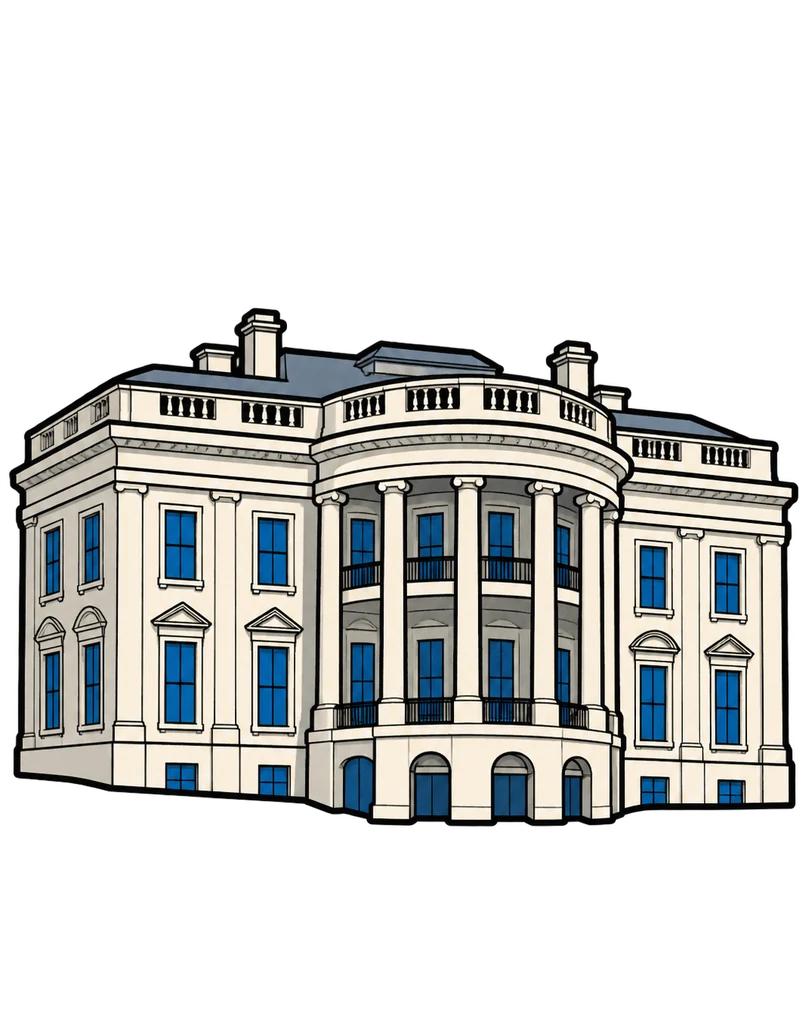
The White House is the oldest public building in Washington that is still used for its first purpose. Every President of the United States has lived there except the first. George Washington chose the site and approved the design, but he left office in 1797, three years before the house was ready. John Adams moved in on 1 November 1800, while the plaster was still wet.
| Building | White House |
|---|---|
| What Wikidata calls it | mansion |
| Capital | Washington, D.C. |
| Form of government | constitutional federal republic |
| Population | 340,110,988 |
The building
The design came from a public competition in 1792. It was won by James Hoban, an architect born in Ireland, and his plan follows the Georgian country houses he had known there. The cornerstone was laid in October 1792. The walls are sandstone, painted white to seal the stone against frost, and people called it the "white house" long before that was its name. Theodore Roosevelt made the name official in 1901.
British troops burned the house in August 1814, during the War of 1812. Only the outer walls survived. Hoban rebuilt it, and James Monroe moved in by 1817.
Most of what visitors now think of as the White House was added in the twentieth century:
- 1902: The West Wing was built as temporary offices, so that the president's staff no longer worked in the family's bedrooms.
- 1909: William Howard Taft added the first Oval Office.
- 1949–1952: The inside of the house had become unsafe. Harry Truman had it taken down to the outer walls and rebuilt on a steel frame, and his family lived across the street in Blair House while the work went on.
- October 2025: The East Wing, added in 1902 and enlarged in 1942, was demolished to make way for a ballroom.
Who held the office
The ledger records 47 presidencies held by 45 people. The two numbers differ because two presidents served terms that were not consecutive. Grover Cleveland was the 22nd and 24th president, and Donald Trump was the 45th and 47th. Each counts once as a person and twice as a presidency.
The United States combines the head of state and the head of government in one office. That is why this page has one lineage, not two. In most parliamentary countries, a monarch or president sits in one building and a prime minister governs from another.
| # | Held by | From | To | Party |
|---|---|---|---|---|
| 47 | Donald Trump | January 20, 2025 | incumbent | Republican Party |
| 46 | Joe Biden | January 20, 2021 | January 20, 2025 | Democratic Party |
| 45 | Donald Trump | January 20, 2017 | January 20, 2021 | Republican Party |
| 44 | Barack Obama | January 20, 2009 | January 20, 2017 | Democratic Party |
| 43 | George W. Bush | January 20, 2001 | January 20, 2009 | Republican Party |
| 42 | Bill Clinton | January 20, 1993 | January 20, 2001 | Democratic Party |
| 41 | George H. W. Bush | January 20, 1989 | January 20, 1993 | Republican Party |
| 40 | Ronald Reagan | January 20, 1981 | January 20, 1989 | Republican Party |
| 39 | Jimmy Carter | January 20, 1977 | January 20, 1981 | Democratic Party |
| 38 | Gerald Ford | August 9, 1974 | January 20, 1977 | Republican Party |
| 37 | Richard Nixon | January 20, 1969 | August 9, 1974 | Republican Party |
| 36 | Lyndon B. Johnson | November 22, 1963 | January 20, 1969 | Democratic Party |
| 35 | John F. Kennedy | January 20, 1961 | November 22, 1963 | Democratic Party |
| 34 | Dwight D. Eisenhower | January 20, 1953 | January 20, 1961 | Republican Party |
| 33 | Harry S. Truman | April 12, 1945 | January 20, 1953 | Democratic Party |
| 32 | Franklin Delano Roosevelt | March 4, 1933 | April 12, 1945 | Democratic Party |
| 31 | Herbert Hoover | March 4, 1929 | March 4, 1933 | Republican Party |
| 30 | Calvin Coolidge | August 2, 1923 | March 4, 1929 | Republican Party |
| 29 | Warren G. Harding | March 4, 1921 | August 2, 1923 | Republican Party |
| 28 | Woodrow Wilson | March 4, 1913 | March 4, 1921 | Democratic Party |
| 27 | William Howard Taft | March 4, 1909 | March 4, 1913 | Republican Party |
| 26 | Theodore Roosevelt | September 14, 1901 | March 4, 1909 | Republican Party |
| 25 | William McKinley | March 4, 1897 | September 14, 1901 | Republican Party |
| 24 | Grover Cleveland | March 4, 1893 | March 4, 1897 | Democratic Party |
| 23 | Benjamin Harrison | March 4, 1889 | March 4, 1893 | Republican Party |
| 22 | Grover Cleveland | March 4, 1885 | March 4, 1889 | Democratic Party |
| 21 | Chester A. Arthur | September 19, 1881 | March 4, 1885 | Republican Party |
| 20 | James A. Garfield | March 4, 1881 | September 19, 1881 | Republican Party |
| 19 | Rutherford B. Hayes | March 4, 1877 | March 4, 1881 | Republican Party |
| 18 | Ulysses S. Grant | March 4, 1869 | March 4, 1877 | Republican Party |
| 17 | Andrew Johnson | April 15, 1865 | March 4, 1869 | Republican Party |
| 16 | Abraham Lincoln | March 4, 1861 | April 15, 1865 | Republican Party |
| 15 | James Buchanan | March 4, 1857 | March 4, 1861 | Democratic Party |
| 14 | Franklin Pierce | March 4, 1853 | March 4, 1857 | Democratic Party |
| 13 | Millard Fillmore | July 9, 1850 | March 4, 1853 | Whig Party |
| 12 | Zachary Taylor | March 4, 1849 | July 9, 1850 | Whig Party |
| 11 | James K. Polk | March 4, 1845 | March 4, 1849 | Democratic Party |
| 10 | John Tyler | April 4, 1841 | March 4, 1845 | Democratic Party |
| 9 | William Henry Harrison | March 4, 1841 | April 4, 1841 | Whig Party |
| 8 | Martin Van Buren | March 4, 1837 | March 4, 1841 | Democratic Party |
| 7 | Andrew Jackson | March 4, 1829 | March 4, 1837 | Democratic Party |
| 6 | John Quincy Adams | March 4, 1825 | March 4, 1829 | Whig Party |
| 5 | James Monroe | March 4, 1817 | March 4, 1825 | Democratic-Republican Party |
| 4 | James Madison | March 4, 1809 | March 4, 1817 | Democratic-Republican Party |
| 3 | Thomas Jefferson | March 4, 1801 | March 4, 1809 | Democratic-Republican Party |
| 2 | John Adams | March 4, 1797 | March 4, 1801 | Federalist Party |
| 1 | George Washington | April 30, 1789 | March 4, 1797 | Federalist Party |
47 tenures. Source: Wikidata, retrieved 2026-09-09.
How the office is filled
The president is elected for four years by the Electoral College, whose members are chosen state by state. Since the Twenty-second Amendment took effect in 1951, no one can be elected more than twice. The Vice President is first in the line of succession, followed by the Speaker of the House and then the President pro tempore of the Senate. The cabinet secretaries follow in the order their departments were created. GovGlobe's United States page shows each of those offices with its own lineage.
Last updated September 22, 2026.